01
DOCUMENT FRAUD BEFORE THE MONEY MOVES
Seeing is no longer believing.
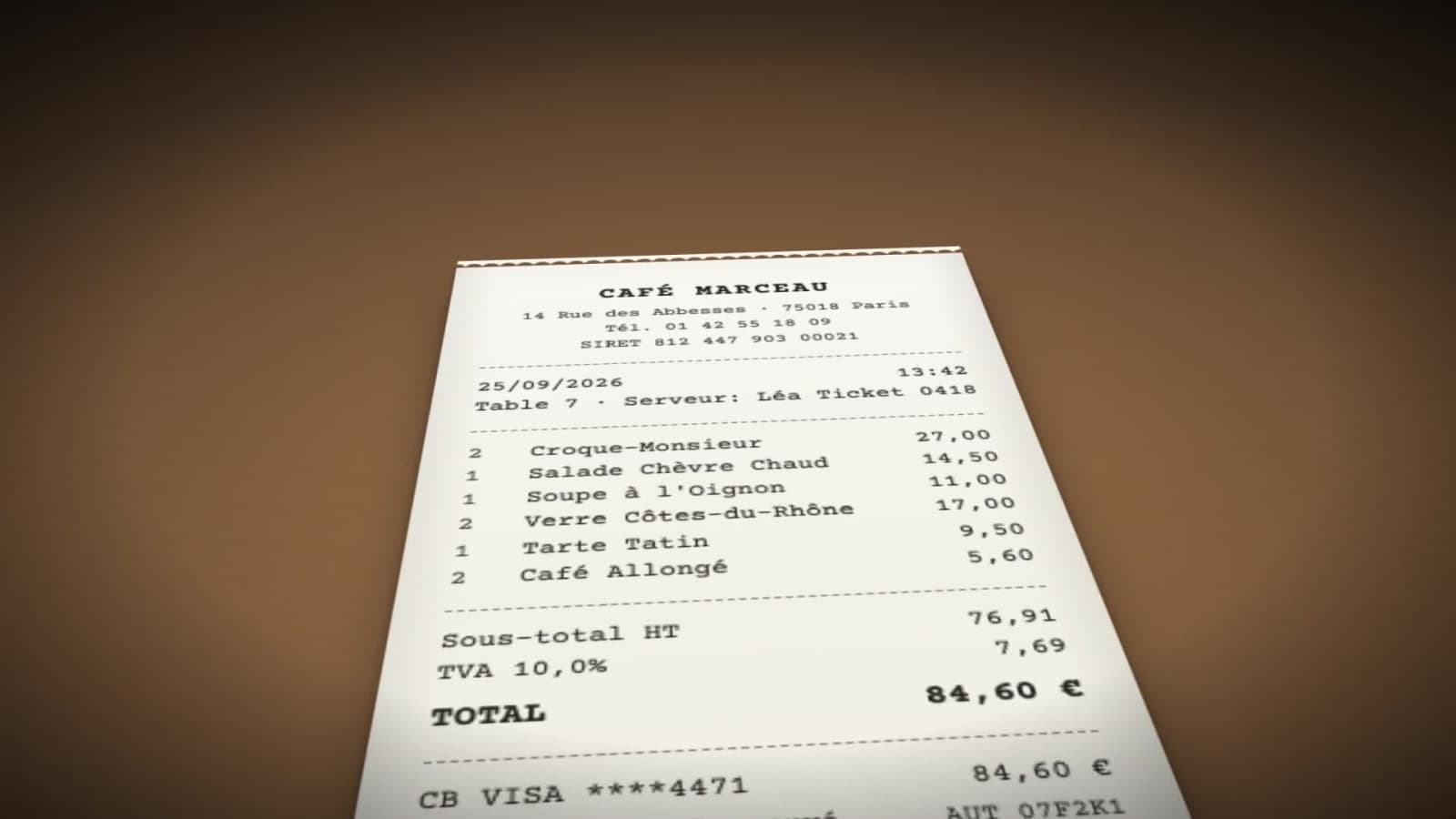
AI-generated invoices, statements, and receipts are already entering payment pipelines, pixel-perfect, invisible to the human eye. Frodau is the system built to surface and catch them before the money goes out.
0:00 / 0:00
Fabricated on demand. No scanner, no scissors, no glue.
02
Invisible to the human eye
03
Detection is just emerging
The record
The loss is already counted.
Up to 10%
of property and casualty loss costs
Insurance Information Institute, cited by the Coalition Against Insurance Fraud
$308.6 billion
annual cost of insurance fraud in the United States
3–10%
of U.S. health-care spending lost to fraud
The same documents
Wherever a document releases money.
Frodau asks the same four questions of each. The film above is one of them, a medical receipt.
Insurance
Medical bills, receipts, invoices, claims evidence, accident documentation.
Banking & Lending
Bank statements, payslips, tax returns, proof of income, IDs.
Healthcare & Medical Payments
Medical bills, prescriptions, clinical records, lab reports.
Corporate Finance / Accounts Payable
Supplier invoices, payment instructions, purchase orders.
Government Benefits & Public Payments
Income evidence, medical certificates, eligibility documents.
Tax & Revenue Authorities
Invoices, receipts, expense evidence, business documentation.
Mortgage & Real-Estate Finance
Income statements, employment verification, valuations, bank statements.
Trade Finance & International Commerce
Commercial invoices, bills of lading, certificates, customs documentation.
Expense Management / Corporate Cards
Hotel, restaurant, transportation and business-expense receipts.
E-commerce & Marketplaces
Purchase receipts, invoices, return documentation and proof of delivery.
How it works
One upload. Four answers in parallel, in seconds.
01
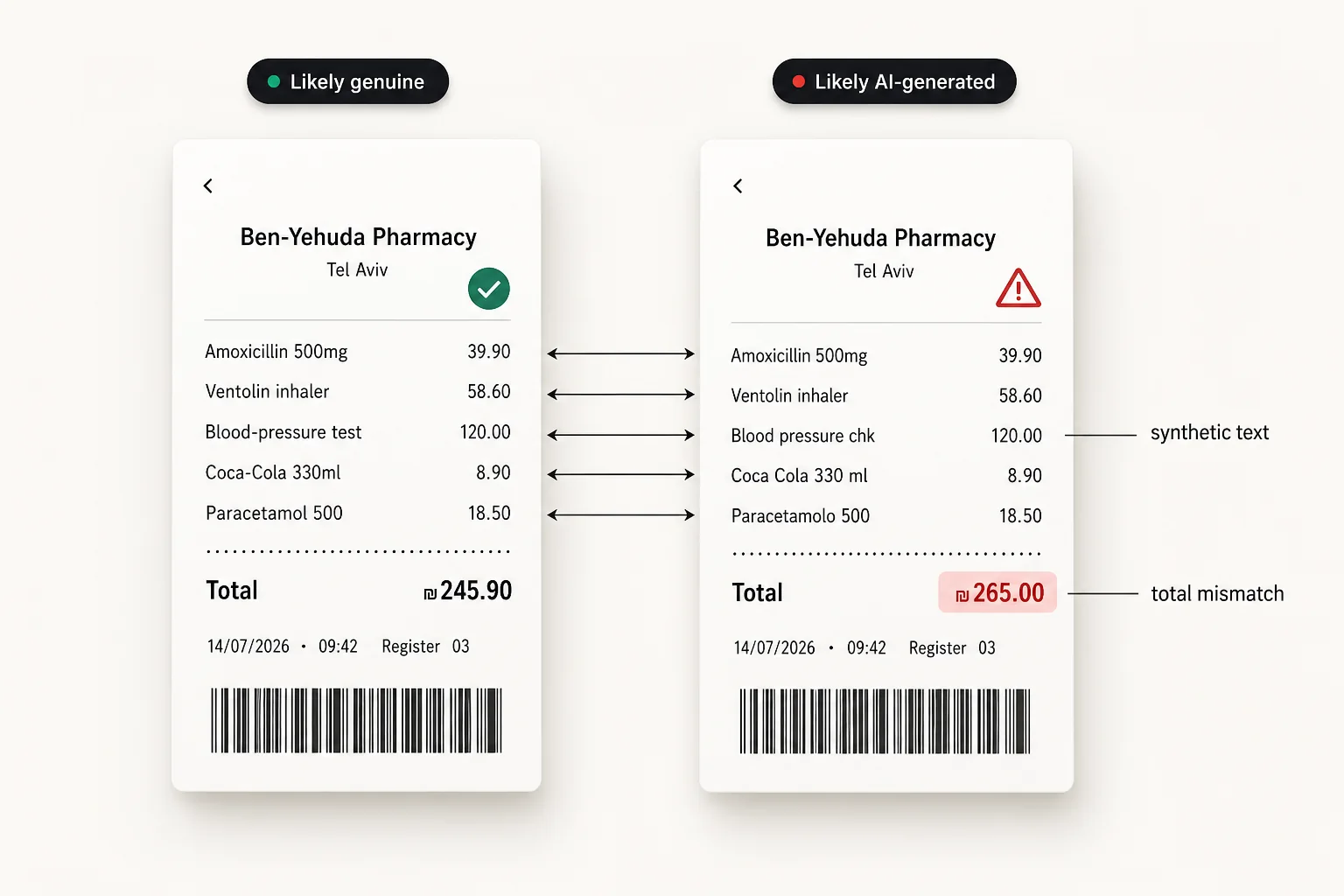
Is it a duplicate?
Fingerprint memory across the whole organization. The same document is never paid twice even cropped, re-photographed, or lightly edited.
02
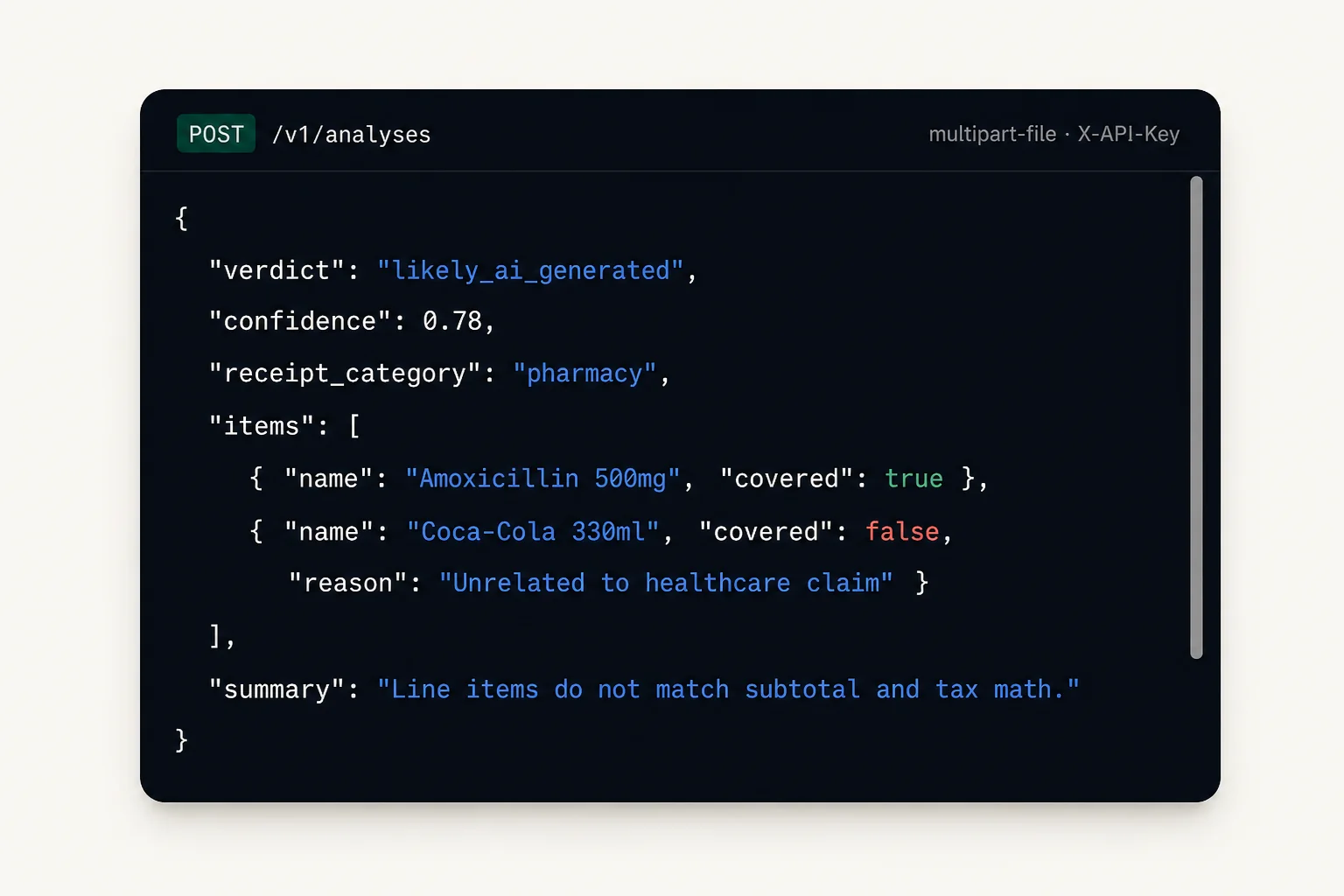
Is it the right document?
Classifies the document type with a confidence score, so the wrong kind of file is flagged immediately. On a claim, that is pharmacy, clinic, dental, lab, or not medical at all.
03
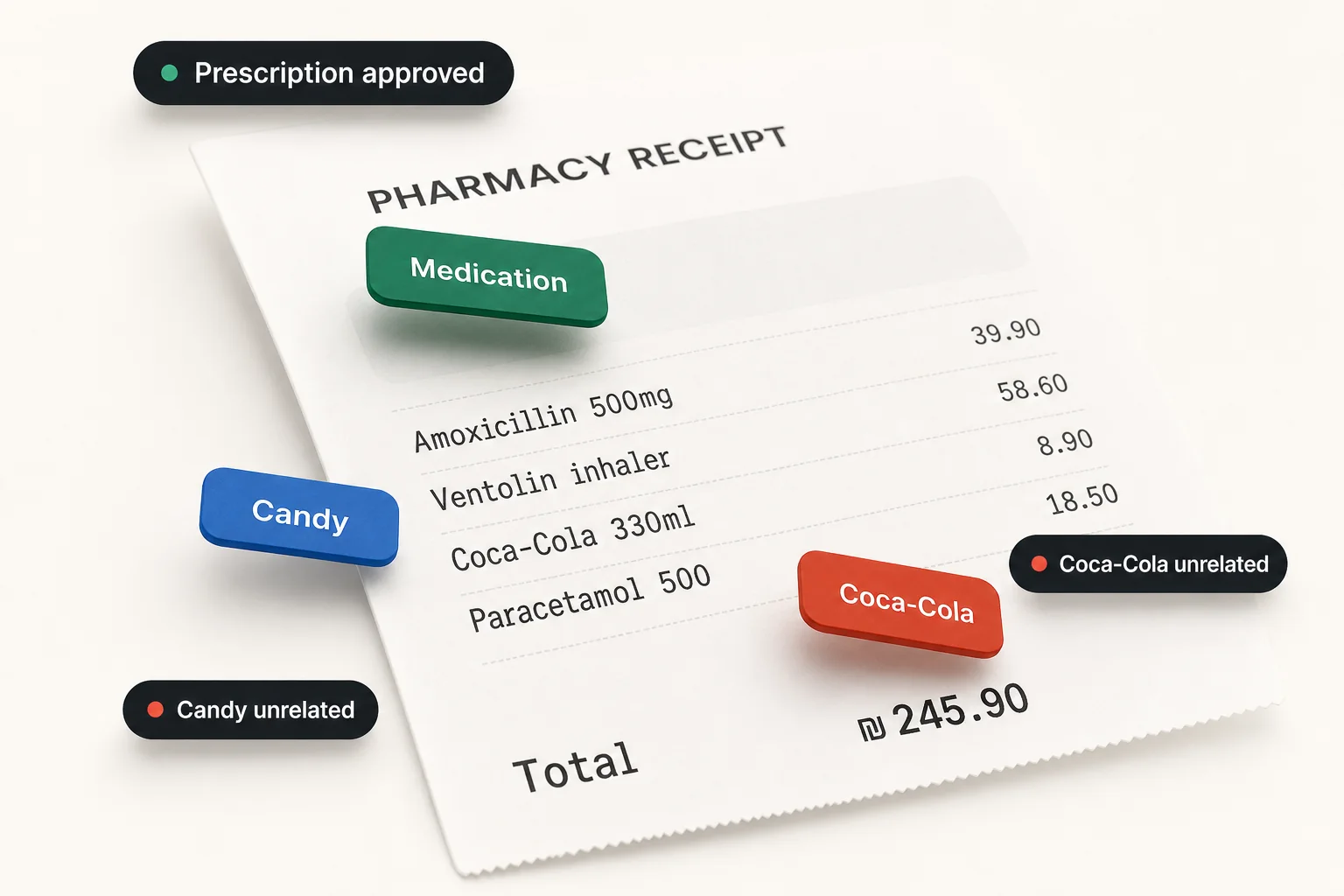
Which lines are payable?
Extracts every line item and marks it covered, excluded, or uncertain. The snack on the pharmacy receipt doesn't ride along with the medication.
04
Is it real?
An ensemble of independent forensic and AI detectors decides: original photo, edited document, or machine-made.
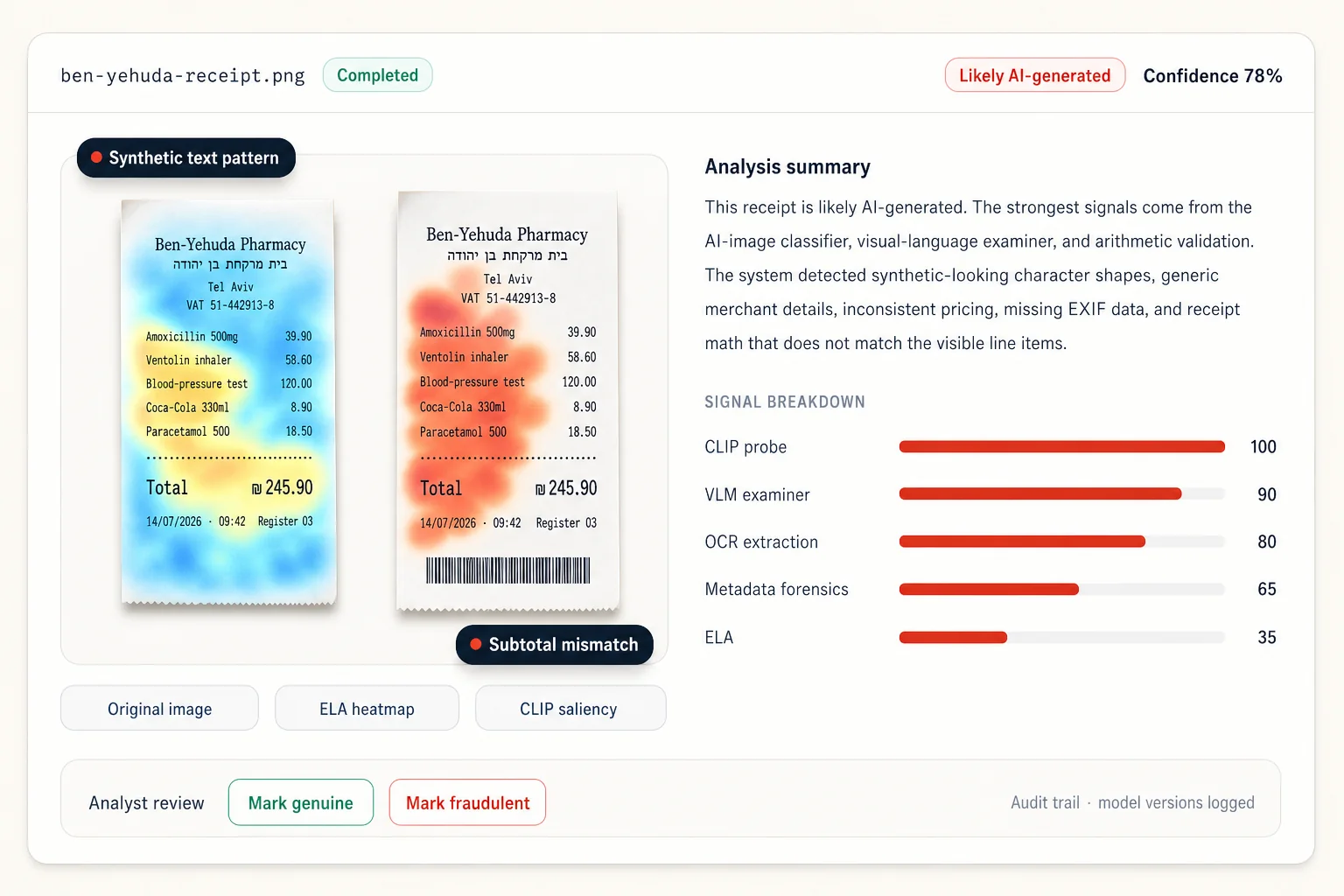
Built for speed: detectors run in parallel when the two commercial AI engines strongly agree, slower checks are skipped entirely.
No single detector decides alone.
Metadata forensics
Camera EXIF, editing traces, AI-generator signatures inside the file
Compression analysis ELA
Heatmaps expose pasted or altered regions the edited total, the classic
2
Two independent AI detectors
Two commercial engines score the same question: was this made by a machine?
Synthetic pattern analysis
Pixel- and style-level signals typical of generative models, not real photography
Semantics & arithmetic
Do the lines add up? Are dates, times, VAT and totals internally consistent?
Medical identifier validation
Provider and drug identifiers, copays and insurance data pass plausibility checks
Visual cross-examination
A vision model gives a second opinion: does the document's story hold?
Duplicate memory
Fingerprint matching against everything the organization has already seen
Careful verdicts, not accusations.
- Likely genuine
- Needs review
- Likely fake / AI
- Inconclusive
Your documents stay yours.
01
Sample documents in the demo
The public demo runs on sample documents. A customer's own files are only handled in that customer's environment.
02
Each customer is separate
One customer's documents and duplicate memory are not visible to another customer, and are not used to train a shared model.
03
Only authorized people
Only people the customer authorizes can open the files. Every verdict keeps its evidence.
04
Encrypted, then deleted
Files are encrypted in transit and at rest. Retention, including the duplicate memory, follows the customer's schedule. When the engagement ends, that environment is deleted.
The customer remains the owner of the documents. Frodau processes them under contract. The same controls are what privacy laws in the customer's industry expect, including GDPR and HIPAA where those laws apply.
What Frodau delivers
01
See the invisible
02
Focus your reviewers
03
End resubmissions
04
Defensible decisions
Our proposal: a controlled pilot on documents you have already paid.
In days, not months we run Frodau inside your own environment on documents you've already paid, show exactly what it would have flagged in real time, and calculate the true savings potential together. The public demo never receives those files.
The question we want to test with you: can Frodau help identify and prevent up to ₪100M in incorrect payments and fraud over time? If we find even a fraction of what we believe is hiding in the data it's millions.